
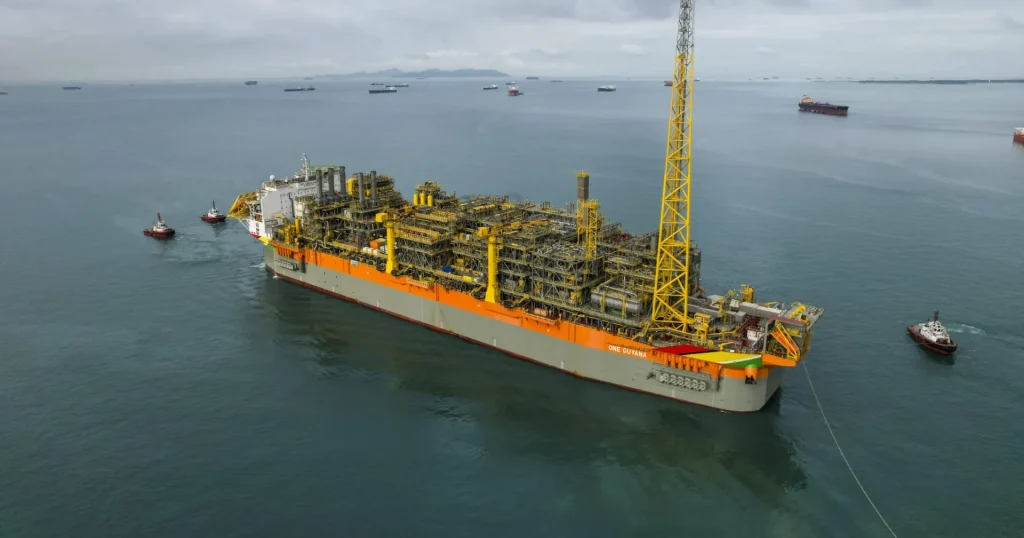
While the world watches the Middle East burn, a quieter story is unfolding much closer to home — and it could reshape the Eastern Caribbean’s energy future.
Guyana, our CARICOM neighbor, is now pumping over 918,000 barrels of oil per day as of February 2026, with capacity projected to reach roughly 1.7 million barrels daily by 2030. That places the former British colony second only to Brazil as South America’s largest oil producer. For a country of less than one million people, the transformation has been staggering — first oil flowed in late 2019, and just over six years later Guyana stands on the verge of crossing the one-million-barrel threshold.
An ExxonMobil-led consortium, with Hess (now under Chevron) and China’s CNOOC as partners, has made over 30 major discoveries in the offshore Stabroek Block, with recoverable resources estimated at more than 11 billion oil-equivalent barrels. Four FPSO vessels are already producing — Liza Phase 1, Liza Phase 2, Payara, and Yellowtail — with the Uaru project expected to come online late 2026, followed by Whiptail in 2027 and Hammerhead in 2029. An eighth project, Longtail, is awaiting a final investment decision.
For St. Vincent and the Grenadines, the story matters on two fronts.
Energy Security in a Volatile World
Iran’s blockade of the Strait of Hormuz, in place since late February 2026, has pushed Brent crude above US$110 per barrel and sparked what the International Energy Agency has called the largest supply disruption in the history of the global oil market. The Americas are scrambling for a reliable supply outside the Middle East. Guyana sits less than 3,000 miles from US Gulf Coast refineries, and US net imports of Guyanese crude averaged near 200,000 barrels per day in 2025 — a record high. That regional shift could eventually stabilize fuel prices for small importing nations like ours, though we should not expect cheap gas at the pump anytime soon.
The Natural Gas Question
More urgently for the Caribbean is natural gas. Trinidad and Tobago — the region’s traditional LNG supplier — has seen LNG exports fall by roughly 40 percent since the COVID-19 pandemic, driven by dwindling reserves and field decline. Guyana’s planned Longtail project, slated for around 2030, is designed to produce 1.2 billion cubic feet of natural gas per day alongside 250,000 barrels of condensate. That positions Guyana as a potential replacement gas supplier for the entire region — a significant shift in Caribbean economic gravity.
Where Does SVG Fit In?
The harder question for SVG is this: as one CARICOM member becomes a petro-state, what is the bloc’s strategy for the rest? Many Caribbean countries spend up to 15 percent of their GDP on imported fuel oil for power generation. We remain net energy importers, vulnerable to every tremor in the Middle East. Guyana’s windfall does not automatically become a regional benefit unless CARICOM negotiates it that way.
There is an opportunity here. There is also a risk that we sit on the sidelines while the regional economic map gets redrawn without us.
Sources
- Matthew Smith, “Guyana’s Oil Boom Will Boost Energy Security in the Americas,” OilPrice.com, 31 March 2026.
- “How Guyana’s Oil Boom Will Reshape Energy Security,” Council on Foreign Relations, February 2026 — used for the 40% Trinidad LNG decline figure and Caribbean energy import statistics.
- “Brazil, Guyana, and Argentina support forecast crude oil growth in 2026,” US Energy Information Administration, December 2025 — production and forecast figures.
- OilNOW — February 2026 production data (918,000 bpd).
- ExxonMobil Guyana — project pipeline details and 1.7 million bpd target.
- 2026 Iran war fuel crisis overview — context on Strait of Hormuz closure and oil price impact.